
 1 / 5
Luxury Villa in Beauvallon – Private Gated Estate Near Saint-Tropez
Overview
19 days on BSRealty, 42 views, 0 saves Property ID: BSR91396Features
Description
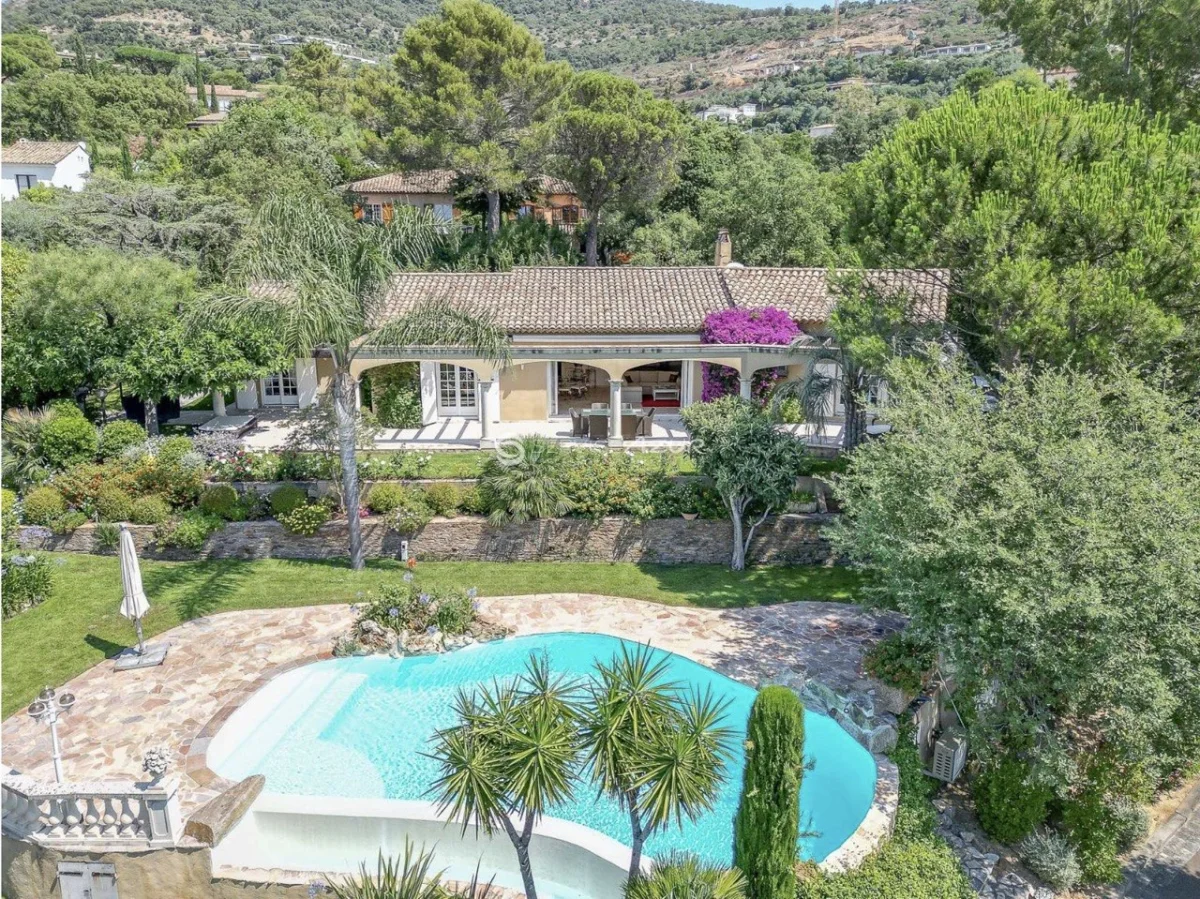
Villa for sale in a prestigious, secure gated estate in Beauvallon, just 1.2 km from sandy beaches, beach clubs, and popular restaurants along the French Riviera. The sea is only a 3-minute drive away.
With approximately 280 sqm… Villa for Sale in a Prestigious Gated Estate in Beauvallon, French Riviera
Villa for sale in a prestigious, secure gated estate in Beauvallon, just 1.2 km from sandy beaches, beach clubs, and popular restaurants along the French Riviera. The sea is only a 3-minute drive away.
With approximately 280 sqm of living space, the villa is set on a beautifully maintained 2,850 sqm plot. It features an entrance hall, a bright living room with panoramic windows and direct access to the terraces, a fully equipped open-plan kitchen, a home office, 3 bedrooms, 3 bathrooms, and a guest toilet.
The lower level also includes an independent studio apartment with a separate entrance, its own kitchen, living area, and bathroom, making it ideal for accommodating guests or staff.
All rooms and terraces offer beautiful views of the surrounding greenery and landscaped garden. The property also features a fully equipped laundry room with facilities for washing, drying, and storage.
The landscaped grounds are adorned with flower beds and Mediterranean plants and include a swimming pool, sun terraces, and several parking spaces.
The villa is in excellent technical condition. In 2010, it underwent a complete renovation, including the replacement of all utility systems, modernization of the interiors, and extensive garden landscaping.
Its exceptional location offers a peaceful atmosphere and complete privacy in one of the most prestigious areas of the Gulf of Saint-Tropez, while remaining close to all local amenities.
The legendary town of Saint-Tropez is just 12 km away, picturesque Port Grimaud and Sainte-Maxime are 7 km away, and Cannes is approximately 80 km from the property.
An ideal choice for a permanent residence, a holiday home, or an investment in luxury real estate on the French Riviera.
The villa is sold fully furnished and equipped. Read more
Mortgage Calculator
Pros of Buying Real Estate in France
France has one of the largest, most diverse, and most established real estate markets in Europe. For ordinary buyers, one of the main advantages is the enormous choice of properties, from city apartments and suburban houses to countryside homes, Alpine chalets, Mediterranean villas, and historic properties.
For local residents, buying property can provide long-term housing stability and an opportunity to build family wealth. France has a strong culture of property ownership, and well-located homes can remain desirable over many economic cycles.
For newcomers and foreign buyers, France offers excellent infrastructure, healthcare, education, transport connections, culture, food, and a wide variety of lifestyles. Buyers can choose between major cities, coastal areas, mountains, countryside, and smaller towns.
Paris is the country's largest and most internationally recognized property market. Demand comes from local residents, businesses, professionals, students, international buyers, and wealthy individuals looking for prime European real estate.
For investors, France offers several very different strategies. Paris and major cities can provide long-term rental demand, while the French Riviera, Provence, the Alps, and selected Atlantic destinations can attract holiday-home buyers and tourists.
Cities such as Lyon, Toulouse, Bordeaux, Lille, Montpellier, and Nantes can offer a more accessible alternative to Paris while still benefiting from employment, universities, infrastructure, and substantial rental markets.
The French Riviera is particularly important for luxury investors. Cannes, Nice, Saint-Tropez, Cap-Ferrat, and other premium coastal locations attract wealthy international buyers and have a limited supply of exceptional properties.
The Alps provide another specialized market. Properties in established ski resorts can benefit from international tourism and demand for second homes, particularly in premium destinations with limited development opportunities.
Another advantage is market depth and liquidity. France has a much larger pool of buyers and tenants than smaller European countries, although liquidity still varies significantly by location.
For long-term buyers, France can therefore offer a combination of lifestyle, rental demand, diversification, capital preservation, and potential appreciation.
Cons of Buying Real Estate in France
One of the main disadvantages is the high cost of buying property in the most desirable locations. Paris, the French Riviera, premium Alpine resorts, and certain major cities can require a very substantial investment.
For ordinary buyers, transaction costs can also be significant. The total budget must account for notary-related costs, taxes, financing expenses, insurance, agency fees where applicable, and other acquisition expenses.
For investors, taxation can be relatively complex. Rental income, capital gains, property ownership, wealth-related taxation in applicable situations, and the buyer's tax residency can all affect the final investment return.
France also has strong tenant protections and extensive rental regulation. In some cities, rent controls or other restrictions can limit an owner's flexibility when setting rents or managing residential property.
Short-term rentals require particular caution. Paris and several other tourist destinations have introduced significant restrictions, registration requirements, and local rules affecting properties used for platforms such as Airbnb.
For foreign buyers and newcomers, French bureaucracy can be difficult to navigate. Property purchases are well regulated, but contracts, taxes, banking, utilities, renovation permissions, and local administration can involve substantial paperwork.
Older properties may require expensive renovation. Historic apartments and countryside houses can have problems involving roofs, insulation, heating, electrical systems, plumbing, damp, structural repairs, or energy efficiency.
Energy-performance regulations are becoming increasingly important. Properties with poor energy ratings can face rental restrictions or require substantial renovation, which can materially change the economics of a seemingly inexpensive investment.
For local residents, affordability is a major problem in Paris, the Riviera, and other highly desirable areas. Property prices can be difficult to manage relative to local household incomes.
For newcomers, French is also important. It is possible to live in some international communities using English, but French becomes much more important when dealing with administration, contractors, healthcare, local services, and long-term integration.
Buying property does not automatically provide the right to reside in France. Property ownership, visas, residence permits, permanent residence, and tax residency are separate matters.
Finally, France is an extremely diverse property market. A prestigious apartment in Paris, a villa near Cannes, a ski chalet in the Alps, and an inexpensive rural house have completely different demand, liquidity, costs, and investment potential. Buyers should therefore evaluate the specific local market rather than treating France as a single real estate market.
Buying Property as a Local Resident
1. Choose the Property
The buyer selects an apartment, house, commercial property, or land and agrees on the basic price and conditions with the seller.
2. Check the Property’s Legal Status
The buyer and notary verify ownership, mortgages, easements, rights of way, planning restrictions, and other legal obligations affecting the property.
3. Review the Property Documentation
The buyer reviews the mandatory diagnostic reports, including energy performance and other technical inspections required for the specific property.
4. Check the Co-Ownership Documents if Buying an Apartment
For a condominium property, the buyer should review the co-ownership rules, service charges, meeting minutes, building finances, planned renovations, and major future expenses.
5. Negotiate the Price and Conditions
The buyer and seller agree on the purchase price, financing conditions, included furniture or equipment, completion date, and other important terms.
6. Make a Purchase Offer
The buyer submits an offer to purchase the property. The legal consequences of the offer should be understood before signing.
7. Sign the Preliminary Purchase Agreement
The parties normally sign a compromis de vente or promesse de vente, setting out the price, conditions, completion deadline, and other terms.
8. Pay the Deposit
The buyer normally pays an agreed deposit, generally held through the notary or another authorized professional rather than being paid informally to the seller.
9. Use the Legal Cooling-Off Period
For qualifying residential purchases, an individual buyer generally benefits from a statutory cooling-off period after receiving the signed preliminary contract.
10. Arrange Financing
If a mortgage is required, the buyer applies for financing. The preliminary agreement can include a financing condition protecting the buyer if the required mortgage cannot be obtained.
11. Complete the Notary’s Due Diligence
The notary checks ownership, mortgages, planning information, rights affecting the property, local authority information, and other documents required for completion.
12. Arrange the Final Funds
Before completion, the buyer transfers the required purchase money and transaction costs to the notary’s account.
13. Sign the Final Deed of Sale
The buyer and seller sign the final acte authentique de vente before the notary.
14. Register the New Ownership
The notary completes the required registration and land-registration formalities following the transaction.
15. Take Possession of the Property
The buyer receives the keys and normally takes possession when the final deed is signed and the transaction is completed.
16. Transfer Utilities, Insurance, and Property Accounts
Electricity, gas, water, insurance, condominium charges, and other property-related accounts are transferred or arranged.
Buying Property as a Foreigner
1. Check Whether You Can Legally Buy the Property
Foreigners can generally purchase residential real estate in France, and French citizenship or residence is normally not required simply to own property.
2. Hire a French Notary
A notary is required for the final property transfer. The buyer can use the same notary as the seller or appoint a separate notary to represent their interests.
3. Consider Hiring an Independent Lawyer or Tax Adviser
Foreign buyers with complex ownership, inheritance, company, financing, or international tax situations may benefit from separate legal and tax advice.
4. Prepare Identification and Source-of-Funds Documents
The buyer should prepare a valid passport or identity document, proof of address, banking information, tax information where required, and documents showing the legal origin of the purchase funds.
5. Review the Property’s Legal and Technical Documentation
The buyer should check ownership, mortgages, easements, planning information, mandatory diagnostic reports, property boundaries, and other relevant documentation.
6. Check the Co-Ownership Documents if Buying an Apartment
The buyer should review service charges, building finances, co-ownership rules, meeting minutes, planned renovations, legal disputes, and major future expenses.
7. Make a Purchase Offer
The foreign buyer submits an offer specifying the price and important conditions of the proposed purchase.
8. Sign the Preliminary Purchase Agreement
The buyer and seller normally sign a compromis de vente or promesse de vente. The contract should include any necessary financing or other protective conditions.
9. Pay the Deposit
The agreed deposit is normally transferred through the notary or another authorized professional according to the preliminary agreement.
10. Use the Applicable Cooling-Off Period
An individual purchasing qualifying residential property generally receives the same statutory cooling-off protection regardless of being a foreign buyer.
11. Arrange Financing if Required
Foreign buyers may apply for French mortgage financing, although banks can require additional equity, income documentation, tax returns, information about foreign assets, and other guarantees.
12. Complete Anti-Money-Laundering and Banking Checks
The notary and financial institutions may require detailed documentation concerning the source of the purchase funds and the buyer’s financial circumstances.
13. Complete the Notary’s Due Diligence
The notary verifies ownership, mortgages, planning information, pre-emption rights where applicable, cadastral information, and other legal requirements before completion.
14. Transfer the Final Purchase Funds
The buyer transfers the remaining purchase price, taxes, notarial costs, and other required amounts through documented banking channels before completion.
15. Sign the Final Deed of Sale
The final acte authentique de vente is signed before the French notary. If the buyer does not understand French, appropriate translation or interpretation may be required.
16. Register the New Ownership
The notary completes the registration formalities and records the ownership transfer with the relevant French authorities.
17. Take Possession and Transfer Property Accounts
The buyer receives the keys and arranges utilities, insurance, condominium payments, and other property-related services.
18. Handle Residency Separately
Buying property in France does not automatically provide the right to live in France. Property ownership, visas, residence permits, permanent residence, and citizenship are separate legal matters.
1. Purchase Costs
| Cost | Amount |
|---|---|
| Resale property — transfer duties (DMTO) | generally up to 6.32% depending on department |
| New-build — reduced registration duties | 0.71% |
| Property security contribution | 0.10% |
| New-build VAT | generally 20% |
| Reduced VAT, qualifying cases | 5.5% |
| Notary remuneration / formalities | according to regulated tariff |
| Real estate agency fee | contractual |
| Mortgage / bank costs | according to lender |
Departments may apply an increased transfer-duty rate until April 2028, which affects acquisition costs for resale property. (Service Public)
Important: New-build and resale properties have significantly different tax structures. New-build property is generally subject to 20% VAT and reduced registration duties, while resale property is mainly subject to transfer duties. (impots.gouv.fr)
2. Additional Costs for Foreign Buyers
| Cost | Amount |
|---|---|
| General additional purchase tax for foreigners | None |
| Translation / interpreter | contractual |
| Legal assistance | contractual |
| International banking costs | according to bank tariffs |
3. Annual Ownership Costs
| Cost | Amount |
|---|---|
| Property tax (Taxe foncière) | depends on property and municipality |
| Taxe d’habitation — where applicable | depends on property / municipality |
| Condominium charges | according to building |
| Property insurance | according to insurer |
| Utilities | based on consumption |
| IFI — real estate wealth tax | may apply above €1.3 million net taxable real estate |
Non-resident owners can also be subject to French local property taxes and, subject to international treaties, IFI where French net taxable real-estate assets exceed €1.3 million. (impots.gouv.fr)
4. Rental Property
| Cost | Rate |
|---|---|
| Rental income tax | according to applicable income-tax regime |
| Social levies — unfurnished rental | generally 17.2% |
| Property management / agency | contractual commission |
For some EEA, Swiss and UK social-security affiliates, CSG/CRDS exemptions apply and the 7.5% solidarity levyremains instead. (impots.gouv.fr)
5. Costs When Selling
| Cost | Rate |
|---|---|
| Capital Gains Tax | 19% of taxable gain |
| Social levies | generally 17.2% |
| Agency fee | contractual commission |
| Legal / administrative costs | depends on transaction |
Important: Capital gains tax applies to the taxable gain, not the total sale price. Exemptions and holding-period reductions can apply; full income-tax exemption is generally reached after 22 years of ownership. (impots.gouv.fr)
1. Paris
1. Best Areas
7th Arrondissement — prestigious, central and elegant; popular with international families and diplomats.
16th Arrondissement — upscale, residential and particularly strong for families and international schools.
Neuilly-sur-Seine — prestigious, green and quiet with excellent family infrastructure.
15th Arrondissement — residential, practical and well suited to families.
17th Arrondissement / Batignolles — attractive, well connected and popular with professionals and families.
2. Safety
7th Arrondissement: High / Very High
16th Arrondissement: Very High
Neuilly-sur-Seine: Very High
15th Arrondissement: High / Very High
Batignolles: High
Overall city safety: Medium-High. Residential western districts are generally calmer, while petty theft is a more significant concern around major tourist attractions, transport hubs and crowded central areas.
3. Education
Excellent. Paris has France's widest selection of public, private, bilingual and international schools, including English-, American, British and other international programmes, as well as world-class universities and grandes écoles.
4. Best For Living
International families, expats, executives, professionals, diplomats, students and people requiring the country's widest choice of international education, healthcare and professional opportunities.
2. Lyon
1. Best Areas
6th Arrondissement — prestigious, central and family-oriented, close to Parc de la Tête d'Or.
Croix-Rousse — distinctive, residential and popular with families and professionals.
Monplaisir — quieter neighbourhood with strong everyday infrastructure.
Tassin-la-Demi-Lune — green suburban environment popular with families.
Écully — upscale western suburb with larger homes and strong educational infrastructure.
2. Safety
6th Arrondissement: High / Very High
Croix-Rousse: High
Monplaisir: High
Tassin-la-Demi-Lune: Very High
Écully: Very High
Overall city safety: High.
3. Education
Excellent. Lyon has strong public and private schools, international and bilingual education and a major university and higher-education sector.
4. Best For Living
Families, professionals, students, healthcare workers, international residents and people wanting a major economic centre with a more manageable scale than Paris.
3. Bordeaux
1. Best Areas
Caudéran — prestigious, green and particularly attractive for families.
Chartrons — fashionable, central and popular with professionals and international residents.
Saint-Seurin / Fondaudège — elegant residential environment close to the centre.
Le Bouscat — quiet, upscale and family-oriented.
Jardin Public — premium central location with greenery and historic architecture.
2. Safety
Caudéran: Very High
Chartrons: High
Saint-Seurin: High / Very High
Le Bouscat: Very High
Jardin Public: High / Very High
Overall city safety: High.
3. Education
Excellent. Bordeaux has strong schools, international and bilingual educational options and major universities and business schools.
4. Best For Living
Families, professionals, expats, students, entrepreneurs and people wanting a major city with strong education, Atlantic access and a comparatively relaxed lifestyle.
4. Toulouse
1. Best Areas
Côte Pavée — prestigious, green and particularly popular with families.
Busca — attractive residential neighbourhood close to the centre.
Saint-Cyprien — lively, well connected and popular with professionals.
Lardenne — quieter suburban environment with houses and greenery.
Pech-David — elevated residential area with more space and access to nature.
2. Safety
Côte Pavée: Very High
Busca: High / Very High
Saint-Cyprien: High
Lardenne: Very High
Pech-David: Very High
Overall city safety: High.
3. Education
Excellent. Toulouse has strong public, private and international schooling and one of France's largest university populations, with particularly strong aerospace and engineering education.
4. Best For Living
Families, engineers, aerospace professionals, students, researchers, expats and people seeking a dynamic southern French city with strong employment opportunities.
5. Nice
1. Best Areas
Cimiez — prestigious, green and one of the strongest family districts.
Mont Boron — upscale hillside neighbourhood with villas and panoramic sea views.
Carré d'Or — premium central location close to the Promenade des Anglais.
Fabron — quieter residential district with modern apartments and sea views.
Saint-Antoine de Ginestière — low-density residential environment with larger homes.
2. Safety
Cimiez: Very High
Mont Boron: Very High
Carré d'Or: High
Fabron: High / Very High
Saint-Antoine: Very High
Overall city safety: High. Greater awareness is appropriate in crowded tourist locations and around major transport hubs.
3. Education
Very Good / Excellent. Nice and the wider Côte d'Azur provide public, private, bilingual and international schools, together with university-level education.
4. Best For Living
International families, retirees, professionals, remote workers, entrepreneurs and people prioritising climate, coastline and an international environment.
6. Nantes
1. Best Areas
Procé — green, established and highly attractive for families.
Monselet — prestigious residential neighbourhood close to the centre.
Saint-Félix — attractive, lively and family-friendly.
Canclaux — quiet and well-established residential district.
Île de Nantes — modern urban environment popular with younger professionals.
2. Safety
Procé: High / Very High
Monselet: High / Very High
Saint-Félix: High
Canclaux: High / Very High
Île de Nantes: Medium-High / High
Overall city safety: Medium-High / High. Safety can vary more noticeably between neighbourhoods, particularly around some nightlife and transport areas.
3. Education
Excellent. Nantes has strong public and private schools, international educational options and significant university and higher-education infrastructure.
4. Best For Living
Families, students, professionals, technology-sector employees and people wanting a green western French city with strong employment and education.
7. Strasbourg
1. Best Areas
Orangerie — prestigious, green and particularly popular with diplomats and international families.
Robertsau — quiet, spacious and family-oriented.
Contades — elegant and central with attractive residential architecture.
Neudorf — practical, well connected and increasingly desirable.
Conseil des XV — upscale residential district close to European institutions.
2. Safety
Orangerie: Very High
Robertsau: Very High
Contades: High / Very High
Neudorf: High
Conseil des XV: Very High
Overall city safety: High.
3. Education
Excellent. Strasbourg has strong French, bilingual and international education, including options particularly suitable for families connected to European institutions.
4. Best For Living
International families, EU professionals, diplomats, academics, students and people wanting a multilingual city with excellent connections to Germany and wider Europe.
8. Rennes
1. Best Areas
Thabor / Saint-Hélier — prestigious, central and close to major parks.
Jeanne d'Arc — quiet, established and popular with families.
Sainte-Thérèse — residential and well connected.
La Poterie — practical family district with good transport.
Cesson-Sévigné — green, affluent suburb popular with professionals and families.
2. Safety
Thabor: High / Very High
Jeanne d'Arc: Very High
Sainte-Thérèse: High / Very High
La Poterie: High
Cesson-Sévigné: Very High
Overall city safety: High.
3. Education
Excellent. Rennes has strong schools, universities and grandes écoles and is one of western France's major student and research centres.
4. Best For Living
Families, students, academics, technology professionals and people seeking a manageable, educated and well-connected regional capital.
9. Annecy
1. Best Areas
Albigny — prestigious lakeside environment close to parks and beaches.
Annecy-le-Vieux — highly desirable, green and particularly strong for families.
Marquisats — attractive lakeside location close to the historic centre.
Novel — practical residential district with schools and services.
Pringy — quieter suburban environment with larger homes and mountain access.
2. Safety
Albigny: Very High
Annecy-le-Vieux: Very High
Marquisats: Very High
Novel: High / Very High
Pringy: Very High
Overall city safety: Very High.
3. Education
Very Good. Strong local schooling is available, while the wider Annecy–Geneva region provides additional international educational options.
4. Best For Living
Families, professionals working around Geneva, remote workers, retirees and people prioritising safety, mountains, lake access and outdoor recreation.
10. Aix-en-Provence
1. Best Areas
Mazarin — prestigious historic district close to the centre.
La Torse — green, quiet and particularly suitable for families.
Val Saint-André — established residential neighbourhood with good everyday infrastructure.
Puyricard — upscale suburban environment with villas and larger properties.
Les Milles — practical for professionals working around the Aix–Marseille business areas.
2. Safety
Mazarin: High / Very High
La Torse: Very High
Val Saint-André: High / Very High
Puyricard: Very High
Les Milles: High
Overall city safety: High / Very High.
3. Education
Excellent. Aix-en-Provence has strong public and private schools, bilingual and international options in the wider Aix–Marseille area and major university and higher-education institutions.
4. Best For Living
Families, professionals, students, academics, international residents and people seeking a high-quality southern French lifestyle with strong education and access to Marseille and the Mediterranean.
Average Real Estate Prices in France
Average Residential Property: approximately €3,000–3,500/m² nationwide.
Apartments — Market Benchmark: approximately €3,000–4,000/m² nationwide, with major regional differences.
New Developments — Average Nationwide: approximately €4,500–5,000/m².
New Developments — Nationwide Market Range: approximately €3,000–15,000+/m², depending on city, location and project quality.
Houses / Villas: approximately €2,500–4,000/m² nationwide.
Luxury Real Estate: approximately €7,000–20,000+/m², with exceptional Paris, Riviera and Alpine properties considerably higher.
Apartment Rent: approximately €600–1,500/month.
House / Villa Rent: approximately €1,000–3,500+/month.
Luxury Rent: approximately €3,000–15,000+/month.
Average Rental Yield: approximately 3–6% annually.
1. Paris
Apartments — Market Benchmark: approximately €9,657/m².
Apartments — Market Range: approximately €6,500–16,200/m², depending on arrondissement and property quality.
New Developments: approximately €10,000–15,000/m². Premium central projects can exceed €20,000/m².
Apartment Rent: approximately €33/m²/month, or roughly €1,300–3,000+/month for typical apartments.
Houses / Villas — Market Benchmark: approximately €10,088/m².
Houses / Villas — Market Range: approximately €6,100–21,500/m².
House / Villa Rent: approximately €3,000–8,000+/month.
Luxury: 6th, 7th, 8th and 16th arrondissements, Saint-Germain-des-Prés, Golden Triangle, Île Saint-Louis and prime Seine-facing properties. Approximately €15,000–30,000+/m². Exceptional trophy properties can be substantially higher.
Luxury Rent: approximately €6,000–20,000+/month.
Investment Potential: ⭐⭐⭐⭐⭐
2. Nice
Apartments — Market Benchmark: approximately €5,206/m².
Apartments — Market Range: approximately €3,300–7,500/m².
New Developments: approximately €5,500–8,000/m². Premium sea-view and waterfront projects can reach €9,000–12,000+/m².
Apartment Rent: approximately €20.7/m²/month, or roughly €800–1,800+/month.
Houses / Villas — Market Benchmark: approximately €6,453/m².
Houses / Villas — Market Range: approximately €3,400–11,600/m².
House / Villa Rent: approximately €2,000–5,000+/month.
Luxury: Mont Boron, Cap de Nice, Cimiez, Carré d'Or and premium Promenade des Anglais properties. Approximately €8,000–15,000+/m².
Luxury Rent: approximately €4,000–12,000+/month.
Investment Potential: ⭐⭐⭐⭐⭐
3. Lyon
Apartments — Market Benchmark: approximately €4,687/m².
Apartments — Market Range: approximately €3,200–6,200/m².
New Developments: approximately €5,000–7,000/m². Premium central developments can exceed €8,000/m².
Apartment Rent: approximately €17.5/m²/month, or roughly €700–1,500/month.
Houses / Villas — Market Benchmark: approximately €5,800/m².
Houses / Villas — Market Range: approximately €3,250–10,400/m².
House / Villa Rent: approximately €1,800–4,000+/month.
Luxury: Presqu'île, Brotteaux, Croix-Rousse, Fourvière, Ainay and premium properties in the 6th arrondissement. Approximately €6,500–10,000+/m².
Luxury Rent: approximately €3,000–7,000+/month.
Investment Potential: ⭐⭐⭐⭐⭐
4. Bordeaux
Apartments — Market Benchmark: approximately €4,375/m².
Apartments — Market Range: approximately €3,000–6,000+/m².
New Developments: approximately €4,500–6,500/m². Premium central and riverfront developments can reach €7,000–9,000+/m².
Apartment Rent: approximately €17.1/m²/month, or roughly €700–1,500/month.
Houses / Villas — Market Benchmark: approximately €4,943/m².
House / Villa Rent: approximately €1,700–4,000+/month.
Luxury: Triangle d'Or, Jardin Public, Chartrons, Caudéran and premium historic properties. Approximately €6,000–10,000+/m².
Luxury Rent: approximately €3,000–7,000+/month.
Investment Potential: ⭐⭐⭐⭐⭐
5. Marseille
Apartments — Market Benchmark: approximately €3,620/m².
Apartments — Market Range: approximately €2,200–5,500/m².
New Developments: approximately €4,000–6,000/m². Premium waterfront projects can reach €7,000–9,000+/m².
Apartment Rent: approximately €16.8/m²/month, or roughly €650–1,400/month.
Houses / Villas — Market Benchmark: approximately €4,946/m².
Houses / Villas — Market Range: approximately €2,500–8,900/m².
House / Villa Rent: approximately €1,500–4,000+/month.
Luxury: Roucas-Blanc, Endoume, Malmousque, Périer, Bompard and premium Corniche properties. Approximately €6,000–10,000+/m².
Luxury Rent: approximately €3,000–8,000+/month.
Investment Potential: ⭐⭐⭐⭐⭐
6. Toulouse
Apartments — Market Benchmark: approximately €3,561/m².
Apartments — Market Range: approximately €2,500–5,000+/m².
New Developments: approximately €4,000–5,500/m². Premium central projects can reach €6,000–7,000+/m².
Apartment Rent: approximately €15.2/m²/month, or roughly €600–1,300/month.
Houses / Villas — Market Benchmark: approximately €4,066/m².
House / Villa Rent: approximately €1,300–3,000+/month.
Luxury: Carmes, Capitole, Saint-Étienne, Côte Pavée and premium properties around Jardin des Plantes. Approximately €5,000–8,000+/m².
Luxury Rent: approximately €2,500–6,000+/month.
Investment Potential: ⭐⭐⭐⭐⭐
7. Aix-en-Provence
Apartments — Market Benchmark: approximately €5,458/m².
Apartments — Market Range: approximately €4,000–7,500+/m².
New Developments: approximately €5,500–8,000/m². Premium central developments can reach €9,000–10,000+/m².
Apartment Rent: approximately €18.4/m²/month, or roughly €750–1,600+/month.
Houses / Villas — Market Benchmark: approximately €6,567/m².
House / Villa Rent: approximately €2,000–5,000+/month.
Luxury: Mazarin, historic centre, Les Pinchinats, Puyricard and premium countryside bastides. Approximately €7,000–12,000+/m².
Luxury Rent: approximately €4,000–10,000+/month.
Investment Potential: ⭐⭐⭐⭐⭐
8. Strasbourg
Apartments — Market Benchmark: approximately €3,726/m².
Apartments — Market Range: approximately €2,700–5,200+/m².
New Developments: approximately €4,000–6,000/m². Premium central and European Quarter developments can reach €6,500–8,000+/m².
Apartment Rent: approximately €15.4/m²/month, or roughly €600–1,300/month.
Houses / Villas — Market Benchmark: approximately €3,604/m².
House / Villa Rent: approximately €1,300–3,000+/month.
Luxury: Grande Île, Orangerie, Contades, Neustadt and premium European Quarter properties. Approximately €5,000–8,000+/m².
Luxury Rent: approximately €2,500–6,000+/month.
Investment Potential: ⭐⭐⭐⭐⭐
9. Nantes
Apartments — Market Benchmark: approximately €3,409/m².
Apartments — Market Range: approximately €2,500–4,800+/m².
New Developments: approximately €4,000–5,500/m². Premium central and Île de Nantes projects can reach €6,000–7,000+/m².
Apartment Rent: approximately €14.6/m²/month, or roughly €550–1,200/month.
Houses / Villas — Market Benchmark: approximately €4,499/m².
House / Villa Rent: approximately €1,300–3,000+/month.
Luxury: Graslin, Monselet, Procé, Saint-Félix and premium Erdre-facing properties. Approximately €5,000–7,500+/m².
Luxury Rent: approximately €2,500–5,500+/month.
Investment Potential: ⭐⭐⭐⭐☆
10. Lille
Apartments — Market Benchmark: approximately €3,374/m².
Apartments — Market Range: approximately €2,500–4,800+/m².
New Developments: approximately €4,000–5,500/m². Premium central developments can reach €6,000–7,000+/m².
Apartment Rent: approximately €16.5/m²/month, or roughly €600–1,300/month.
Houses / Villas — Market Benchmark: approximately €3,540/m².
House / Villa Rent: approximately €1,200–2,800+/month.
Luxury: Vieux-Lille, Vauban-Esquermes, Centre and premium properties around the Citadelle. Approximately €5,000–7,500+/m².
Luxury Rent: approximately €2,500–5,500+/month.
Investment Potential: ⭐⭐⭐⭐⭐
Market Note: France has one of Europe's widest residential price spreads. Paris averages approximately €9,657/m² for apartments, compared with €5,206/m² in Nice, €4,687/m² in Lyon, €4,375/m² in Bordeaux and €3,620/m² in Marseille. New developments should therefore be treated as a nationwide market range rather than a single upper price limit: regional projects can start around €3,000/m², while prime Paris, Côte d'Azur and Alpine developments can exceed €15,000/m².
France
Foreign individuals and non-residents may generally purchase real estate in France.
There is no general requirement to obtain a special property-acquisition permit solely because the purchaser is a foreign national.
A foreign buyer may acquire an apartment, house or other ordinary privately owned property through the standard French conveyancing process, which normally involves a notary.
Planning restrictions, agricultural rules, statutory rights of pre-emption and other property-specific restrictions may apply to the particular property, but they do not constitute a general prohibition on foreign ownership.
Purchasing real estate does not itself give a foreign buyer an automatic right to reside in France.